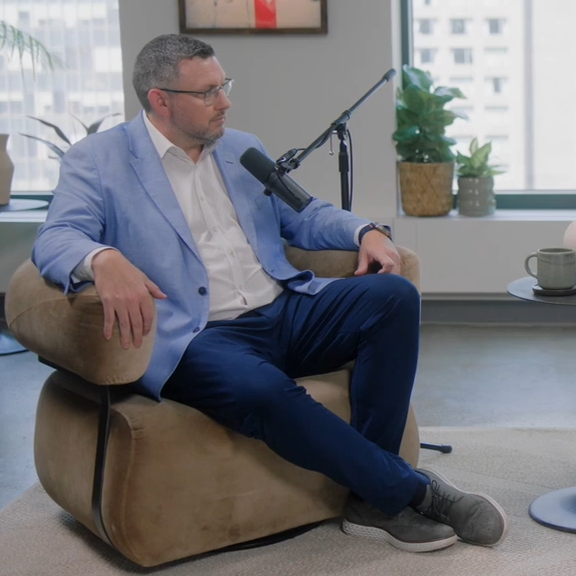
Edwina Lowe (00:12) Hi, I'm Edwina Lowe, product specialist within the Data Assets and Alpha Group.
Eloise Goulder (00:18) And hi, I'm Eloise Goulder, head of the Data Assets and Alpha Group, which sits within the prime financial services organization within the trading business here at JP Morgan.
Edwina Lowe (00:27) So Eloise, um, could we go back a few steps and talk about the creation and reason for our team, the Data Assets and Alpha Group?
Eloise Goulder (00:35) Absolutely. So we created the group six years ago, it was in 2019, and really we created it to try and pull together two significant functions within the trading organization. So one of them was the market intelligence function. This is a function that has been around for more than a decade. It predates my life at JP Morgan, and really the market intelligence function is providing on the pulse market dynamics and interpretation of what is going on. Based on political developments, based on macro catalysts, based on results season and what the thematic drivers of the, of results season might be, that is what our market intelligence function does. But in addition to that, and we really wanted to beef up that function and make it a true coordinated global function when we set up the group, we also wanted to add in the data-driven lens. That's so important, partly because our clients demand for data, uh, and data-driven insights has only been increasing over that period, but it's also because it's so important that our markets insights are as unbiased as we can make them, are very tactical, our, um, are very catalyst driven.
Eloise Goulder (01:52) That's so important for our market intelligence function. And it really goes both ways. Our market in- intelligence function is more powerful with that data-driven lens and the other parts of our team, our data intelligence team and our positioning intelligence team, which together make up our overall group, are so much more powerful if they have a market's nous, if they are topical, if we can bring to life those data sets with relevant market insights.
Edwina Lowe (02:18) Absolutely. And where do you see the intersection of those three distinct pillars of the team coming together?
Eloise Goulder (02:25) Well, I do like to think the sum is so much more significant than each one of those parts, and there are so many areas that intersect those three pillars. I mean, Edwina, your role really spans all of those pillars. You're involved in so many cross-group projects. Perhaps I can turn that question back to you.
Edwina Lowe (02:44) Yeah. I mean, I think from my perspective, the opportunity to speak to clients cross-team, so pulling together different parts of our team for our client conversations can be really powerful and certainly appreciated by our clients. But in terms of our products, I think I would single out the podcast as a great example of that team collaboration and bringing the threads of our team together. I mean, we launched our series three years ago, and I think it's a fantastic example of showcasing everything we do as a team, but also the opportunity to bring together other colleagues from the wider markets business. So for example, one of our recurring themes, as you well know, is the retail investor and the rise of the retail investor. So the opportunity to look at that through a number of different lenses and bring in colleagues that can also speak to that theme.
Eloise Goulder (03:34) And it's interesting, we, I think at the outset of the podcast, we just saw it as another means of communication, another means of content dissemination. We have the written content from our market and our positioning intelligence teams. We have the data content, the API content, which of course is an enormous growth area, which I'm sure we'll talk about today. And the podcast, another audio means of disseminating content, which of course has been growing across the world and across our industry. But what I've learned, and I'm sure you feel the same, Edwina, is actually, it's a way of creating new ideas, new insights, which you couldn't create if you didn't put those subject matter experts in a room together to have that discussion. Um, in that so many topics don't have a firm conclusion. It's not as simple as question, three bullets and a conclusion. So many questions are so nuanced.
Eloise Goulder (04:30) You know, we're tackling should, uh, will US exceptionalism continue, will it last, or will other economies start to outperform, and will other market assets start to outperform? We're covering the rise of the retail investor in so many markets, in US markets, in Asian markets, and what the implications of that are. We're covering behavioral biases and the extent to which we can both try to mitigate them in investing decisions, but also how we can capitalize on them to create, to, to attempt to create alpha generating opportunities. These are such complex topics, and it's n- and most of them don't have a clear cut answer. It would be naive for us to assume that there is a, a clear cut answer. So I do think the power of the podcast, the power of the audio conversation is so significant because you can really, you can learn so much, but also you can share and articulate the nuance of the argument.
Edwina Lowe (05:25) And really the beauty is in that nuance. Could we focus on our team name, the Data Assets and Alpha Group? I've been in the team a little over three years, but I'm aware that the team predates me. Could you talk a little bit about that, Eloise?
Eloise Goulder (05:37) Yeah, absolutely. Well, in a way, I think we do exactly what we say on the tin. We are the Data Assets and Alpha Group. What do I mean by that? Well, we are creating and curating data sets from across our market's trading organization. They may be positioning related, uh, data sets, hedge fund positioning, they might be social sentiment related data sets. What are our interpretations of sentiment based on scanning the multitudes of posts on social media? Uh, so we're creating all of those datasets, but why are we creating them? Why are we, why are we in the pursuit of the creation of those datasets? It's because we're using them for predictive purposes within markets. We're using them to help have a lens on which markets and which assets and which stocks will outperform or underperform, and therein lies the alpha term. It's all about alpha generation at the end of the day.
Eloise Goulder (06:32) So we are the Data Assets and the Alpha Team, and we wouldn't want to care about the data assets without that alpha focus. Alpha is the core of everything that we do.
Edwina Lowe (06:42) So Eloise, a question that comes up a lot is what distinguishes us in the Data Assets and Alpha Group from the research organization. Could you talk a little bit about that?
Eloise Goulder (06:52) Yes, absolutely. And we do get that question quite a lot. So we are distinct from research. We have a very strong relationship with research. That is critical. It's so important we understand what research are doing and saying, whether that's from the macro lens or the micro bottom up stock picking lens or indeed the quant lens, but we're distinct. We sit within the trading organization here at JP Morgan. And why are we different? Well, first of all, the very data assets that we create and that we curate, they come from the trading organization. They are very separate from research. Those data assets include hedge fund positioning from our prime business where we sit. For example, they include all of our analysis around social media, social media sentiment as a lens on the retail investor, which has become so significant. Those data assets, they sit within the trading organization and therefore we sit within the trading organization.
Eloise Goulder (07:51) Second of all, this very tactical intraday activity, these insights, that very often sits within the trading organization across the industry, and indeed it sits within the trading organization here.
Edwina Lowe (08:03) Yeah, that's very clear. Thank you. And actually, I'd like to pick up on that point of the data sets. You know, I know as a team, we are responsible for creating data sets, these predictive trading datasets and insights, but could you expand a bit about what that actually means and looks like in practice?
Eloise Goulder (08:19) Definitely. And before going into detail on perhaps one or two of those datasets, it's worth noting that in creating these datasets and in providing insights on those datasets, we're striving to really open the box, open the lid on our analysis so that we're not simply presenting opinions and views, but we are actually fully open source in a sense. If we have a view on a market or a stock or an asset, uh, yes, you can listen to the opinion, you can listen to our podcast, you can read our written content on that opinion, but you can also download the dataset behind that opinion via an API, do the analysis yourself, stress test that analysis yourself, and importantly, critically utilize that in the future so you don't have to speak to us every minute of every day, uh, but you can put that dataset in with all of the other datasets you source in order to see how that view will materialize through time.
Eloise Goulder (09:13) And I think that's so critical. That's why we are creating data-driven insights and we are both making the insights themselves available, but also the underlying datasets. It's all about opening up, being transparent, being as unbiased as possible, we're showing our workings, which I think is so critical.
Edwina Lowe (09:30) My obvious next question is, what do those datasets actually look like? And in terms of the creation of new datasets, how do you go about that process?
Eloise Goulder (09:40) Yes. Well, it's a great question and it's worth bearing in mind that our datasets should be we strive for, for them to be as proprietary as possible. And by that, I mean, we're either leveraging proprietary data assets that sit within our organization or, and/or we're leveraging proprietary techniques on top of perhaps publicly available data sources or commercially available data sources, but we are using the full breadth, scale, and technological capabilities that we have available to us at JP Morgan to create proprietary analytics on those data sets. So let me give one example, prime positioning. By that, I mean, we look at the aggregated and the critically anonymized collation of hedge fund positions from our Primebook. This is a give to get model. Clients opt into this dataset, but to the extent that the vast majority of our clients do opt into that dataset, we create an aggregated and an anonymized lens on the positioning of those clients in given stocks and in given indices and markets at a given point in time, on a daily basis, lagged by three days in this case.
Eloise Goulder (10:55) Now, it's absolutely critical that this dataset is aggregated and anonymized so that our clients feel comfortable that no individual client position can be back derived.
Edwina Lowe (11:08) And that's really critical.
Eloise Goulder (11:09) It's absolutely critical. So what sort of techniques do we use to ensure that that is the case? We use, for example, winsorization. By that, I mean, we chop off the tails of a distribution so that any extreme position is normalized and is taken out. We bucketize, and by that, I mean, we don't provide precise numbers for all of our data sets, but for some of our datasets, we just simply put them into buckets like deciles, and therefore you can only see if it changes if it moves from one bucket to another. We cap weightings. So if a given client or a given client's position exceeds a given percent weighting, we will cap it to ensure that outsized positions aren't showcased. These enhancements are absolutely critical to the dataset, most importantly, to make sure that they are truly anonymized, but also to make sure that we're taking out extreme so that we have a representative series over time for our datasets.
Eloise Goulder (12:04) So that's our prime positioning hedge fund dataset, for example. That's very clearly leveraging proprietary data that we have available to us as a result of the scale of the prime business here. Now, to give another example, which is not at its genesis utilizing a proprietary dataset, but does, I would argue, utilize a proprietary analytical technique, this would be our social media, social sentiment dataset, which you know so well. Here, again, it's a single stock dataset. It has significant history. Going back to 2009, it's provided on a daily basis. Here, we are ultimately developing relationships with social media companies. We have a paid for license with them to utilize it, to aggregate it, but this is an enormous dataset, and it's very hard to disentangle a signal from that noise, so to speak.
Edwina Lowe (12:59) And social media is a fantastic lens by which you can understand or try and understand retail investor activity.
Eloise Goulder (13:05) And it has been quite a feat to ingest that in such a way that we believe it has predictive power. We believe it has use for the investment process for us internally within JP Morgan and for our client base. So what have we done here in terms of the process? Well, even to ingest these millions of posts that are available to us, we have to spike detect. We can't possibly bring them all in to our platform. That alone is just too much data. So we have to spike detect to, to identify which data points we believe are worthy of coming in. They are either data points that relate to specific assets that we care about. For example, we track 3,000 stocks within the US and/or their posts that have significantly increased over time, which warrants their inclusion. So first of all, we do that. We then need to entity map those posts to determine which stocks or assets or entities they relate to.
Eloise Goulder (14:00) For example, if we're looking at posts relating to Apple, do we, are we taking Apple the fruit or are we taking Apple, the company? That in itself is such a critical distinction. So we've had to use our partners in the Machine Learning Center of Excellence, their techniques to correctly or as accurately as we can, entity map all of these posts to real financial assets that we care about. We not only create a volumes dataset, which is really how many posts are there for a given asset on a given day over time, but we also need to create the sentiment related to those posts over time. And sentiment analysis, I mean, it's really evolved over the years. 10 years ago, we utilized traditional NLP, natural language processing, and very traditional, arguably quite simplistic approaches were, for example, bag of words. Let's get a bag of positive words like up, beat, and a bag of negative words like down, disappoint, and let's map those posts to that bag of words to infer a sentiment for those interactions.
Eloise Goulder (15:04) But thankfully, technology has enormously helped us with that job. Um, we can now leverage LLMs to help annotate different posts, which has been transformational, as you mentioned earlier. We also leverage transformer models on the NLPs. For example, Google's Bert model and Facebook's Roberta, a really, uh, an augmentation of Google's Bert model. We utilize that specifically to aid this sentiment generation process.
Edwina Lowe (15:32) And to be able to look at that nuance that's not simply positive or negative. And actually, incredibly topical to be talking about this because we've seen a big resurgence of the retail investor this year, and in fact, the meme phenomena come back. So this is a very topical dataset that's, uh, highly appreciate or highly utilized by our clients.
Eloise Goulder (15:51) Yeah, absolutely. And when I think about the datasets that our clients are asking us the most for, I would say it comes down to positioning flows, sentiment based on as many sources as possible and textual data, as you mentioned before. I think all of those topics come up.
Edwina Lowe (16:07) I agree.
Eloise Goulder (16:08) And so what have we been developing in that space? Well, on the positioning side, we obviously have our hedge fund positioning dataset. We augment that with positioning from as many other investor types as we can track. So we look at retail investor flows, which as you say, have been on the rise, particularly post- COVID and indeed this year. We look at ETF flows, we look at CTA, inferred CTA positioning, we look at mutual fund positioning, we aggregate all of that together to have a lens on the aggregation of that positioning, that's our tactical positioning monitor, which itself is another dataset. That's the positioning and flows lens. We then have an equivalent for sentiment. We obviously have social sentiment, a lens on the retail investor. We now have professional sentiment, a lens on the institutional investor, and we have the aggregated tactical sentiment monitor, which really pulls all of these together.
Eloise Goulder (17:00) And of course, we could talk about the predictive power of each one of these series, which is a whole another debate. Uh, but that is absolutely critical when we're having our conversations with our clients is not only what data do you have, what are the attributes of those datasets, how much history, how much lag, how can I access it? But it's also what, what are the lessons you've learned? What are the predictive analytics that you've learned so far through all of your back tests? So there are obviously so many data sets that we can look at that we can create. There's such a journey in front of us in terms of continuing to enhance this. And of course, we're always client led. And Edwina, you're speaking to the clients, you're hearing from them about what they want to see. Can you speak to what clients have been asking for and also how we determine which data sets to prioritize?
Edwina Lowe (17:48) Yeah, it's a great question and it's a little bit of a balancing act in reality. Um, it, you know, to, to echo your point, the client feedback is absolutely critical in terms of determining our pipeline and where we allocate resource. You know, just to be very clear about this, bringing a new dataset to market is a considerable endeavor and doesn't just involve our team. We work with, as the point you made earlier, our partners across the business at JP Morgan. So we really need to make sure that when we put that effort in and allocate that resource, that we have the client demand to make it worthwhile, but that also has to be balanced with what's actually realistic, you know, in terms of really boring things perhaps, but things like licensing are absolutely critical. And when you talk about proprietary data, that comes with a whole host of sensitivities around it.
Edwina Lowe (18:37) But in terms of what's actually being demanded, or sorry, what's, in terms of what, where the client demand is, I would say that the rise of sentiment as a theme, so wanting to understand through a variety of different sources, what different investor types are thinking about or what the sentiment where the sentiment sits is key. So you talked about social media as a lens for the retail investor, but what we're now trying to do is broaden those horizons to try and have a lens on sentiment for the institutional investor. And of course, when we talk about the institutional investor, there are a variety of different investor types within that bucket, but one of the, um, an area that we're expanding upon is looking at reports or documentation from the industry to try and understand institutional sentiment. And then obviously within that, there's more that we can do.
Edwina Lowe (19:33) So we could look at different types of client or different types of investor, and we could also look at, for example, regional variations. There's a lot we can do there.
Eloise Goulder (19:43) Absolutely. And that demand for institutional, professional, textual content is so rife right now, isn't it? And that demand to consume it in a machine readable form so that it can be put into the knowledge basis, uh, of, of our investing clients. And whenever we present these data sets, it's so important for us to put them in a markets context and to look at them continuously through a markets context. Just to give a couple of examples, when we went through the real market lows in early April, the S&P 500, it dropped around 20% post liberation day. And at that time, our positioning data sets and specifically our tactical positioning monitor, it fell dramatically and it actually triggered an attractive signal based on our back tests. And this is something that our positioning intelligence team regularly write about, but even more powerful was to have an awareness of the market dynamics at the time.
Eloise Goulder (20:36) The fact that developments in the US political situation were very rapid. We had the 90 day pause in tariffs announced, and perhaps as a result of that, coupled with the fact that positioning levels were, were low, which is historically quite a ripe time to buy equities, markets then rebounded. And we've continued to see markets rebound since then driven by the retail investor, which comes back to all of our retail datasets, retail flows, retail net flows increasing, retail sentiment never actually got as light and it has been increasing. So I think putting these datasets into the market's context so that when we're using them real time on an ongoing basis, we can either read the datasets as they are through a purely systematic basis, which has an enormous amount of merit is arguably the most unbiased way of looking at the data, or we can add that quantitative view to more of a discretionary view in terms of how catalysts in the market are playing out to come up with more of a quantamental or a, a combined view, marrying the systematic with the discretionary view.
Eloise Goulder (21:38) That's also so powerful. And really as a team, we strive to do both.
Edwina Lowe (21:42) Well, arguably that's where our edge lies.
Eloise Goulder (21:45) Yes, indeed. So it's pulling together those threads from our market intelligence who, who are tracking markets real time through the day, leveraging these data sets with our positioning intelligence team who are doing exactly that, but specifically focused on positioning data to our da- data intelligence team, which is much more the data science capabilities creating these datasets such as social media. It's, it's combining, it's that aggregation of them all that we believe
Edwina Lowe (22:10) To be so powerful. And really that's at the heart of what our clients are looking for from us, is bringing those threads together to provide that combined lens.
Eloise Goulder (22:19) Absolutely. And isn't it so interesting and such a privilege for us to be facing all of these different investor types from the quants to the discretionary, to everything in between, from the portfolio managers and the analysts, uh, to the traders, to the central data sourcing teams, and to hear about their evolving client needs, which are evolving so rapidly and to be doing our best to service those needs.
Edwina Lowe (22:43) Eloise, I've heard you speak compellingly in the past about continuous learning and, you know, really honing intellectual curiosity. Could you talk a little bit about what that means to you and what you do in practice?
Eloise Goulder (22:55) I mean, I do think it entails listening to the client, the voice of the client. That's absolutely critical. It also entails being willing to accept feedback. It's not always fun learning that you need to change something, you need to create something different, you don't know where to start in terms of identifying a new data point, but at the end of the day, it's only hearing all of those requests that gives us a lens on our clients and how they're evolving and what they want. And it's the accumulation of all of that. It's the iterative process of all of those discussions that really builds our knowledge base over time and that really builds our capability to service our clients over time. And I really embrace that. I love that. What do you think, Edwina?
Edwina Lowe (23:39) I think it's a great point, but in terms of what it actually looks like, I mean, I'll speak for myself personally. I make an effort every morning to start with listening to a 10-minute news briefing so that I have some idea of what's going on in the market and the wider world. I find that 10 minutes a very manageable amount of time and actually the cumulative effect of that is significant. I, I also like scanning the newspapers and understanding what's going on. And then I, you know, without doubt, our colleagues, whether that's within our own team and we all sit together or across the wider business, but maintaining that curiosity and that seeing learning as an ongoing thing is vital. It's vital for continuous development and for being the best we can possibly be. And I'd like to talk to you a little bit about mentorship, both in terms of mentors for you or being a mentor to people who are earlier in their career.
Edwina Lowe (24:34) What does that mean to you?
Eloise Goulder (24:36) It's so important to continuously mentor, whether that's a formal mentee mentor rel- relationship or more commonly, I would argue across the industry, and for me, it's more of an informal thing. It's so important. I mean, if we look, if I look at my mentors, I almost call them our team stakeholders, as you know. And for a team like ours that's somewhat hybrid, that sits within trading, that's very close to research, that's very close to sales, that's very close to the data science and the data-driven parts of our organization, we have many stakeholders. And yes, that's a responsibility because we need to make sure that what we're doing is fully aligned with their businesses, but it's also such a privilege, such an opportunity to have those relationships with those individuals, all of those relationships different. But I really try to take on board the advice that they will give me and give our team in helping to steer our team in the most effective commercial direction.
Eloise Goulder (25:37) I see those, in a sense, as mentoring relationships, because those people are in good faith giving the best advice they can to me and to our team. And I really value those relationships. But equally, the importance of mentoring others, guiding others, supporting others, it can't be understated. I think for individuals in the organization to know that we are all approachable, we should all be approachable and that we all will take the time to hear concerns, to hear, uh, challenges, and to provide our feedback on that, I think it's completely critical for the ecosystem to work well. It's also, by the way, as powerful for the mentor as the mentee. And, and I truly believe that in all, in all senses. You know, for myself, if I meet with someone in a different business or perhaps in a business that's closer to us, and I hear their challenges and their concerns, I always learn something new.
Eloise Goulder (26:28) I love being able to help to the extent that I think I've got experience that, that might be relevant. Um, and I so often am reminded of things which are, which are critical to my own career and to our own team and to our own development. So I do see these relationships, they don't need to be formalized. In fact, overly formalizing them can, uh, can take away from the natural rapport and the natural dialogue and conversation, um, that's required, but I do believe they're really important. Another attribute that I think is, is really important to perhaps underestimating is consistency of delivery and following up. And it's relevant when it comes to stakeholder management, mentee, mentorship. I always love it when, um, people that I've, I've mentored follow up with interesting snippets, interesting articles, podcast recommendations, pieces of news. I love it when they do that because it's strengthening our relationship.
Eloise Goulder (27:24) It's keeping that line of communication open, which means the probability of us reaching out to each other in the future is that much higher. Uh, it's also truly informative and we learn much more from each other through that process. And, and I think that's so important in all directions. So the significance of following up, of consistently doing what you said you'd do, of consistently following through, um, it is, it does ultimately require a lot of hard work. And perhaps that sounds boring, perhaps that sounds dry, but to me, that is the greatest inspiration for creativity. You only really learn new things by doing, and you only really see parallels between different processes by doing, and therein lies so much of our creativity at the end of the day.